Skipping the Part Clients Hate
An AI-powered solution that streamlines the Cloud application assessment phase, helping consultancies move faster, reduce costs and remove one of the most common blockers to winning migration engagements.
The Challenge
Cloud migrations rarely fail in the execution. They fail before they begin.
Consulting companies specialising in Cloud migrations often face challenges when clients resist paying an initial Cloud assessment. The main issue stems from the perception that the assessment is an “additional cost” with no immediate value to the core goal of migration, which is the transfer of the applications to the Cloud.
From the organisation’s perspective, the need for Cloud migration often stems from a desire to reduce costs, increase efficiency or modernise operations. In some cases, the initial assessment is done as a very first step of the migration journey and they are cautious about any upfront investments to third-party consultancies.
Cloud application assessments are often perceived as an “additional cost” by organisations. Streamlining this process and minimising costs can deliver significant value.
The Solution
AI Cloud Migrator compresses the assessment phase, making it faster to run, cheaper to deliver and easier to justify to clients who are already sceptical of upfront spend.
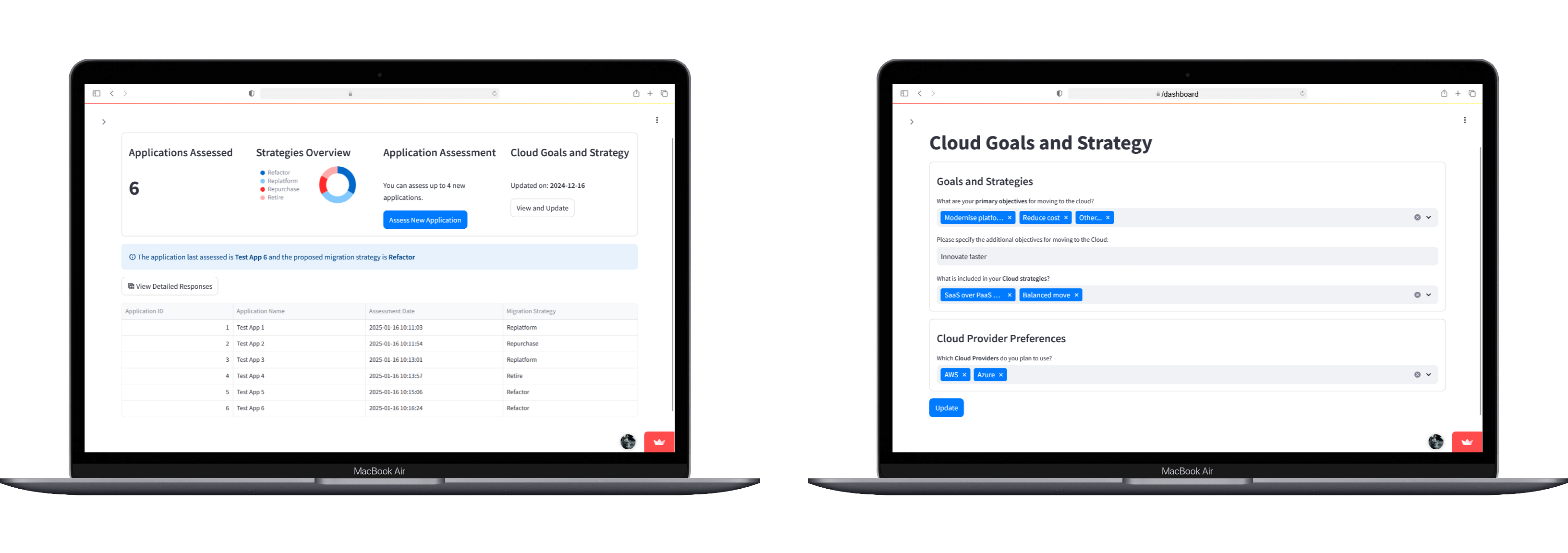
The tool combines application-specific technical information with an organisation’s Cloud goals and constraints, using AI to analyse the inputs and recommend a tailored migration strategy for each application. Where larger consultancies rely on proprietary data collection frameworks that take weeks to run, AI Cloud Migrator produces actionable outputs in a fraction of the time without requiring lengthy onboarding or specialist training to use.
The tool also supports bulk assessment, enabling teams to process multiple applications simultaneously and align each migration strategy with the organisation’s overarching Cloud objectives. The result is a structured, consistent assessment output that consultancies can present to clients with confidence — and that clients can actually engage with.
Behind the Build
I led the team as both Product Manager and AI and Technical Lead, working with an engineer and a Cloud architect to design, build, and bring the tool to market.
The cross-functional dynamic was one of the more interesting challenges. Cloud architecture carries its own deep expertise and strong opinions, translating between what the AI model could reliably produce and what a Cloud architect would consider a credible, defensible recommendation required ongoing negotiation. Getting those two domains to speak the same language was as much a product problem as a technical one.
On the AI side, the core work was prompt engineering and model optimisation to ensure the tool’s outputs reflected real migration best practices rather than generic Cloud advice. A recommendation that is technically correct but ignores an organisation’s compliance constraints or legacy dependencies is not useful, so a significant portion of the build was spent on making the tool’s reasoning sensitive to organisational context, not just application specs.
I also led the market research that shaped the initial feature set and drove the commercial work, identifying consulting partners, structuring the pilot engagements, and managing the integrations into their existing delivery workflows.
Results
AI Cloud Migrator is in active use with a group of consulting organisations, integrated into their assessment workflows.
Initial deployments show a 60% reduction in assessment phase duration and a 50% reduction in resource demands, time and cost that goes directly back into the engagement.