Rethinking How Product Teams Prioritise
The Challenge
Product Managers face the ongoing challenge of ruthless prioritisation throughout the product lifecycle.
For Product Managers, ruthless prioritisation is a constant balancing act, making tough calls while ensuring every decision stays true to the product vision.
Ensuring that every decision aligns with the product strategy and vision is critical, but this process is often slow, complex, time-consuming and prone to misalignment. As a result, teams often end up prioritising features that fail to deliver the desired impact.
The Solution
Our goal is to simplify and enhance the prioritisation process for product teams. The Product Work Focus Tool automates the assessment and prioritisation of product features based on your product strategy and vision, while keeping Product Managers in full control. Product Managers can review and adjust inputs at any time, ensuring final priorities remain aligned with product goals.
Leveraging AI, the tool analyses product information to generate key dimensions for prioritisation. Each new feature is assessed across these dimensions, with its priority calculated based on both impact and effort.
Additionally, the tool creates a high-level delivery plan, using resource and capacity data to help teams map out the implementation of future features effectively.
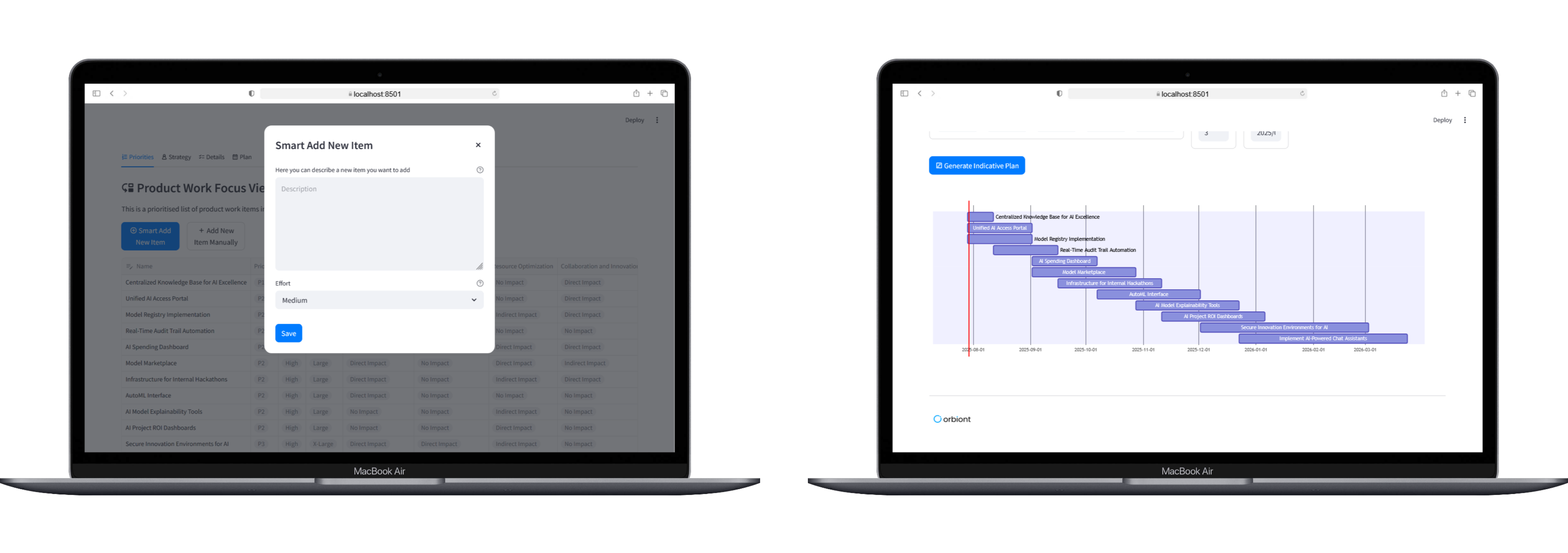
The tool analyses and prioritises new features from a simple description and generates an indicative high-level plan to support future implementation.
Key Features
- AI-powered analysis of product information, strategy, and vision
- Automatic generation of prioritization dimensions for consistent decision-making
- Manual editing of product information and prioritization criteria for full control
- Intelligent feature assessment based on descriptions, with impact analysis across all dimensions
- Automated priority scoring calculated from overall impact and effort
- Transparent rationale for every impact assessment, providing clear decision support
- High-level implementation planning based on team capacity and resource data
Behind the Build
I took on both the Technical Lead and Product Manager roles for this project. I wanted to experience firsthand the tension between what is technically feasible and what a PM actually needs, and let that inform every decision.
The hardest problem was not building the tool, it was designing the prioritisation framework that powers it. Generic prioritisation models like RICE or MoSCoW are well understood, but they are product-agnostic by design. Making AI derive contextually meaningful dimensions from a specific product’s strategy required significant prompt engineering and iterative testing to get the outputs to a point where experienced PMs found them credible rather than generic.
On the AI side, I optimised the assessment workflow to balance depth with speed, early versions produced thorough but slow analyses that interrupted the flow of a prioritisation session. Getting the latency down without sacrificing the quality of the rationale was a meaningful technical challenge.
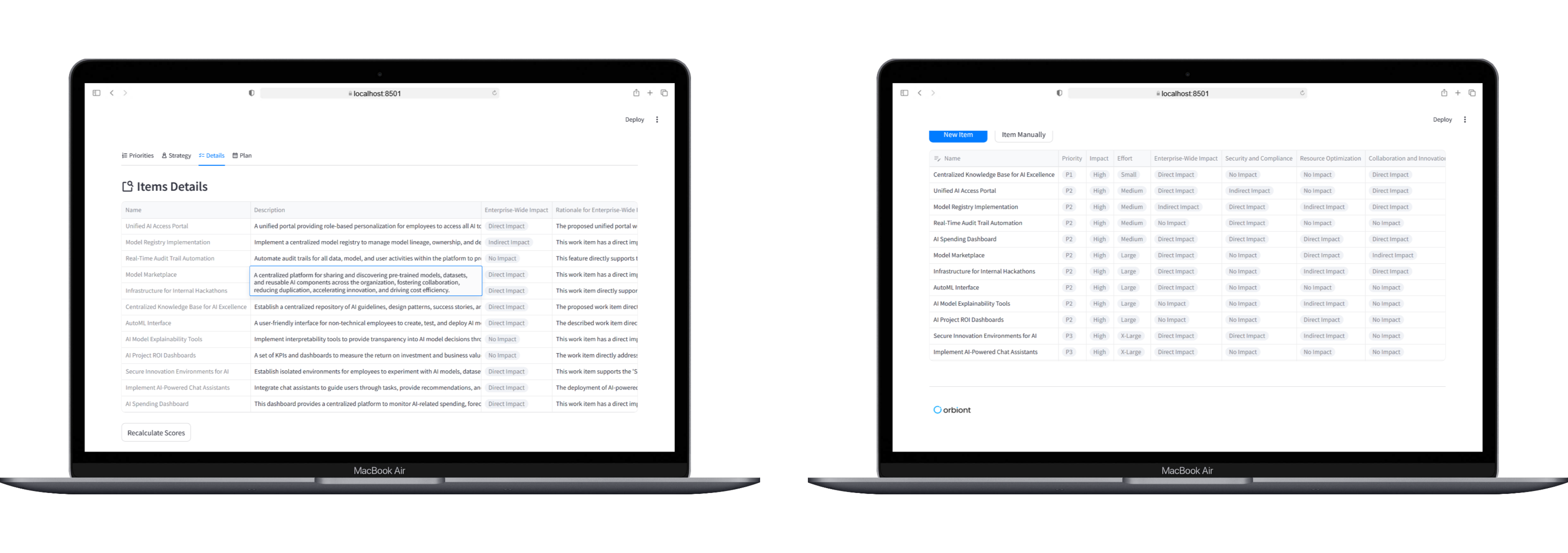
The tool provides clear rationale for each impact assessment, offering insight into how the model “thinks”. Teams can also manually adjust values to tailor priorities using their expertise and context beyond the tool’s data.
Results
Early testing with a select group of Product Managers shows that the tool cuts the time needed to prioritise a feature and generate an initial delivery plan by up to 50%. More importantly, participants reported that the process felt more defensible, the rationale gave them something concrete to discuss and refine with their teams, rather than starting from scratch.
What Came Next
This tool did not stay an experiment. It became the foundation for the AI product platform I built at Kantar with Copilot Studio.
The ideas proved out here, deriving prioritisation dimensions from product strategy, assessing work consistently and keeping the Product Manager in control, carried over into the platform. It has made my team more efficient and lets us absorb more products without growing the team in step.