The Diagram That Takes Three Days to Draw
An AI-powered solution that transforms unstructured interview data into a visual overview diagram by identifying relationships and interactions among participants, giving consultants and organisations a faster path from discovery to insight.
The Challenge
Understanding how value moves through an organisation requires talking to people. Teams conduct rounds of interviews across departments, gathering perspectives on how work flows, who depends on whom, and where things slow down or break down.
The interviews themselves are not the hard part. What comes after is.
Synthesising notes from multiple interviews, often conducted by different consultants with different shorthand, different interpretations, different levels of detail, into a single coherent diagram is slow, subjective and surprisingly fragile. A diagram that one consultant reads as showing a clear bottleneck might look like normal workflow friction to another. By the time the team has agreed on what the data is actually saying, significant time has passed and the client is already questioning the cost of the engagement.
Understanding team interactions is crucial for organisations seeking to streamline and optimise their processes and structures. However, evaluating how value is currently delivered can often be both time-consuming and costly.
The Solution
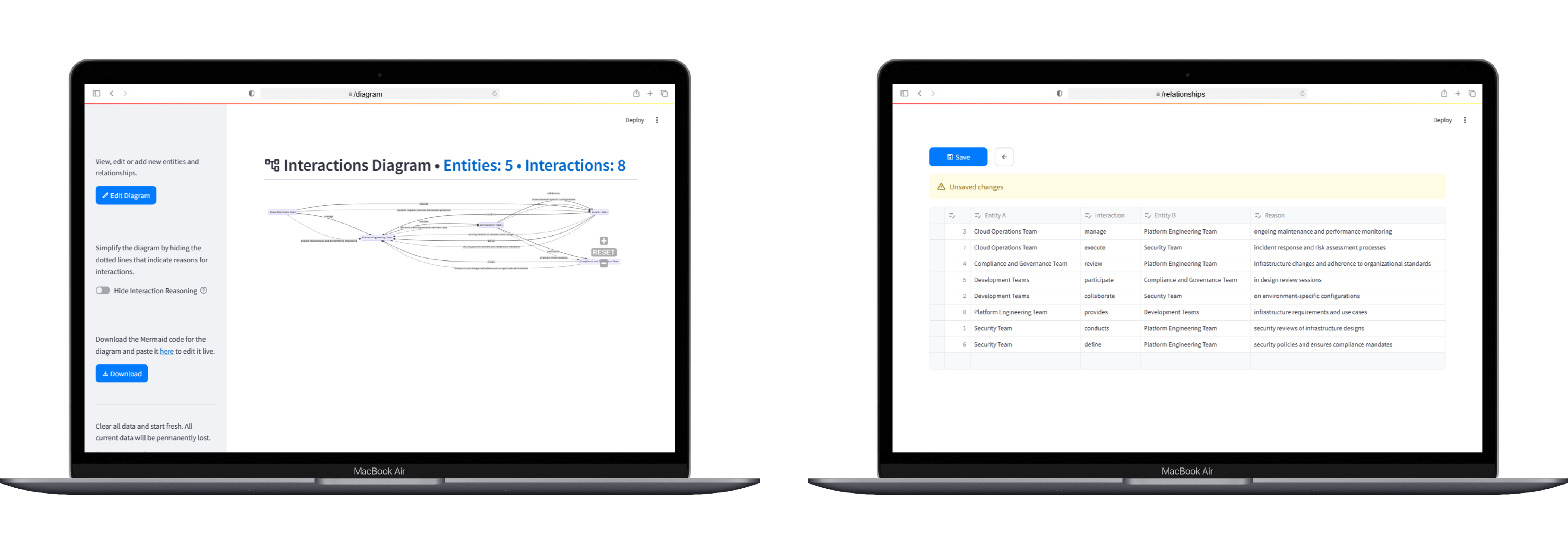
Relationships Mapping Visualiser takes raw interview notes, unstructured, messy, written exactly the way people actually write field notes, and analyses them to identify participants, relationships and interactions. It then generates a visual diagram of how value flows across teams and tools, ready to review in minutes rather than days.
The tool was deliberately designed with a human-in-the-loop approach and that decision matters. AI models are good at pattern recognition across large amounts of text, but they make mistakes, misattributing a relationship, conflating two teams, missing a nuance that only makes sense in context. Rather than hiding that limitation, the tool surfaces the underlying data and makes it easy to correct; team names, interactions and relationships are all editable through a simple interface, with the diagram updating in real time. Users can also export the Mermaid code directly to the Mermaid liver editor for deeper customisation.
The tool works best when the interview inputs are structured consistently. A questionnaire guide is available to help teams capture information in a format that produces the most accurate outputs.
Behind the Build
Designed and built end-to-end by me, from the AI integration and prompt engineering to the interface and diagram rendering. I work closely with a group of consultants who use the tool in active engagements, which provides a continuous feedback loop for improving accuracy and usability.
The most interesting design challenge was the human-in-the-loop layer. Getting the AI to produce a good first-pass diagram was the tractable problem, prompt engineering and iterative testing got the outputs to a reliable baseline relatively quickly. The harder question was how to make corrections fast and intuitive enough that consultants would actually make them rather than abandoning the tool when the AI got something wrong. If fixing an error takes longer than drawing the diagram by hand, the tool has failed. Getting that edit experience right took more iteration than the AI work itself.
Results
Deployed in small and medium-sized organisations, the tool has demonstrably changed how long the discovery-to-diagram process takes.
Initial deployments show an 80% reduction in time spent creating the interactions diagram and a 15% reduction in overall process assessment time.
The 80% figure is the one that lands with consultants. It turns a task that used to consume most of a working day into something that happens before the debrief meeting ends. That time goes back into analysis and client conversation, which is where the real value of a consulting engagement sits.